
Why now
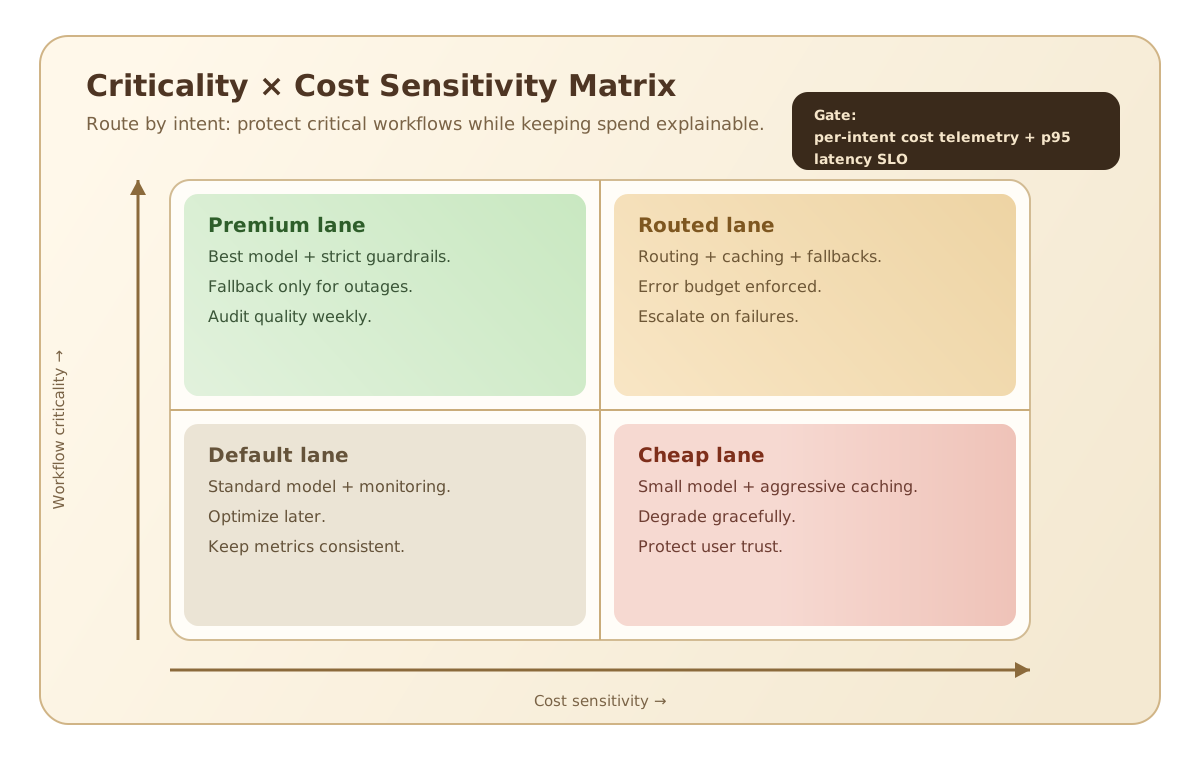
Route requests by intent, use caching, and define fallbacks so cost stays predictable without sacrificing quality.
- Model spend is volatile or hard to explain at leadership review.
Playbook
Short answer
Route requests by intent, use caching, and define fallbacks so cost stays predictable without sacrificing quality.

Key takeaways
Why now
What breaks without this
Decision framework
Recommended path
Implementation sequence
Tradeoffs and counterarguments
| Criterion | Recommended when | Use caution when |
|---|---|---|
Model spend is volatile or hard to explain at leadership review. | Model spend is volatile or hard to explain at leadership review. | Small prototypes with trivial request volume. |
Critical workflows require fallback behavior when model latency spikes. | Critical workflows require fallback behavior when model latency spikes. | Teams without observability into model usage patterns. |
Teams can instrument quality and cost metrics for every request class. | Teams can instrument quality and cost metrics for every request class. | Programs unwilling to tune prompts and routing policies over time. |
Phase 1
4-week implementation baseline plus ongoing tuning cadence.
System flow
Before and after scenario
Weekly loop
Measure → tune routing/prompts → retest
Before
Small prototypes with trivial request volume.
After
Prompt-caching and routing policies can materially reduce repeat-context inference spend.
Evidence lens
Prompt caching directly reduces repeated-context token spend in production traffic.
OpenAI • 2024-10-01 • vendor release
Metric context
OpenAI Prompt Caching launched with a 50% discount on cached input tokens.
Caveat
Discount applies when prompts share a cacheable prefix and model support is enabled.
Model portfolio routing can move both latency and unit economics, not just quality.
OpenAI • 2025-04-14 • vendor release
Metric context
GPT-4.1 mini delivers nearly half the latency and 83% lower cost versus GPT-4o.
Caveat
Performance and cost outcomes vary by task mix, prompt length, and reliability thresholds.
Caching economics improved further on newer model families, amplifying routing impact.
OpenAI • 2025-04-14 • vendor release
Metric context
GPT-4.1 introduced a 75% prompt-caching discount for repeated context.
Caveat
Savings depend on repeated prefixes and disciplined prompt/version management.
Cross-provider evidence shows caching can improve both spend and responsiveness for long prompts.
Anthropic • 2025-03-13 • vendor release
Metric context
Anthropic reports up to 90% cost reduction and up to 85% lower latency with prompt caching.
Caveat
Vendor-reported maxima require workload-level validation before budget commitments.
Release reliability should be run as a measurement system, not a one-time launch check.
DORA / Google Cloud • 2024 • industry survey
Metric context
DORA 2024 synthesized responses from 39,000+ professionals across organizations.
Caveat
Survey-level findings are directional; validate with your own request-class telemetry.
Security and reliability guardrails must be encoded in routing policy, not bolted on later.
OWASP Foundation • 2025 • industry survey
Metric context
OWASP identifies 10 recurring LLM application risk classes requiring explicit mitigations.
Caveat
Risk prevalence differs by architecture, but control classes remain broadly transferable.
Small prototypes with trivial request volume.
Why: this usually signals governance, ownership, or data-readiness gaps that increase misroute risk.
Teams without observability into model usage patterns.
Why: this usually signals governance, ownership, or data-readiness gaps that increase misroute risk.
Programs unwilling to tune prompts and routing policies over time.
Why: this usually signals governance, ownership, or data-readiness gaps that increase misroute risk.
Will cheaper models always save money?
Not always.
Lower unit cost can increase retries or review effort if quality drops.
How is reliability measured?
Reliability should track latency, failure rate, and downstream human rework.
Actionable next step
We can pressure-test this decision against your exact workflow, risk posture, and rollout constraints in one working session.
Book an AI discovery call→