Use case

Build an Internal AI Answer System

Short answer

Build an internal answer layer on your docs, not a generic chatbot. Enforce permissions at retrieval time and require citations for important claims. If confidence is low, return “no answer” and escalate. Fine-tune only when retrieval, prompting, and policy still cannot deliver the behavior you need.

Enterprise knowledge archive scene for a retrieval-backed answer layer with citations
Help teams decide whether to ship a retrieval-backed enterprise knowledge answer layer (RAG), and how to do it with citations, permissions, and eval gates.

Decision narrative

Key takeaways

  • Ship an answer layer, not a chatbot: retrieval + citations + permissions + eval gates.
  • Treat “no answer” as a feature; abstain and escalate when retrieval confidence is low.
  • Citations are a safety boundary, not decoration; audit citation faithfulness.
  • RAG wins by freshness and governance; fine-tune only when behavior cannot be solved with context.
  • Operate weekly: eval regressions, content fixes, retrieval tuning, and policy updates.

The bottleneck is not finding docs. The bottleneck is trusting answers.

  • Search returns documents; operators need decision-ready synthesis with citations.
  • Time saved compounds when repeated questions are deflected without breaking trust.
Deep dive and caveats
  • The fastest path to value is a narrow domain with gates, not enterprise-wide “AI search” day one.
  • Fed evidence is self-reported and modeled; treat as directional motivation, not proof of ROI for your domain.
  • Your go/no-go should be based on local telemetry: deflection rate, citation clicks, and error recovery time.

Most RAG failures are access, grounding, or citation failures.

  • If retrieval ignores ACLs, you will leak sensitive knowledge and lose trust immediately.
  • If citations are unfaithful, the UI looks rigorous while the system stays wrong.
Deep dive and caveats
  • If you skip evals, you cannot tell whether changes improved truth or just fluency.
  • Treat citation faithfulness as a metric: sample answers weekly, label support, and fix in a loop.
  • Adopt OWASP-style threat coverage (prompt injection, data leakage, tool misuse) before broad rollout.

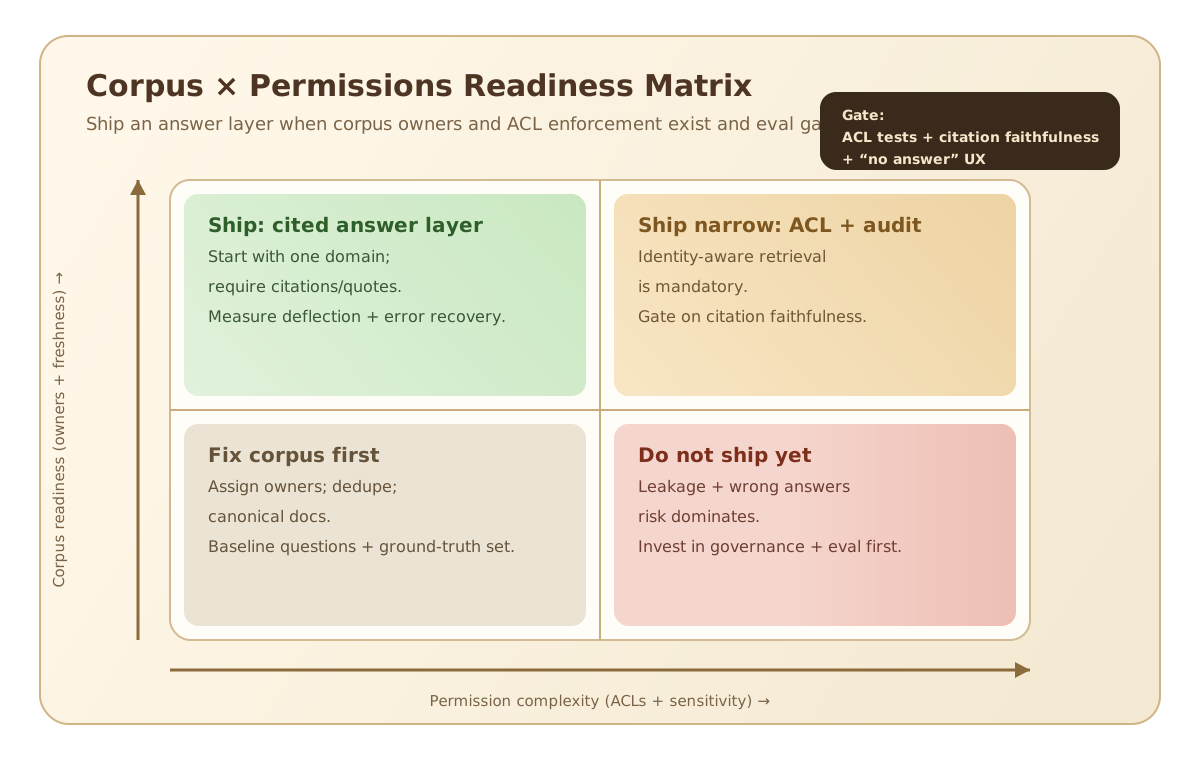
Do not launch until three gates are ready: corpus, permissions, and eval.

  • Corpus readiness: owners, freshness, de-duplication, and canonical sources per topic.
  • Permission readiness: identity-aware retrieval, least-privilege defaults, and audit logs.
Deep dive and caveats
  • Eval readiness: grounded-answer tests, refusal quality, latency/cost budgets, and drift alerts.
  • Use NIST AI RMF (Govern, Map, Measure, Manage) as the governance spine: owners, metrics, and change control.

Recommended path

+14%workflow lift signal

Start with retrieval plus citations, and expand only after evals are stable.

  • Pick one high-value domain (e.g., support policy, incident response, finance close) and ship there first.
  • Require citations/quotes for non-trivial claims and log citation clicks and escalations as outcome signals.
Deep dive and caveats
  • Add fine-tuning only after retrieval/prompt/policy cannot satisfy output-format or behavior constraints.
  • Treat external productivity studies as directional; your internal deflection and error-recovery metrics decide scale.

Ship in phases: instrument, ground, evaluate, then scale.

  • Weeks 1-2: instrument questions, define intents, and collect a baseline answer set with ground truth.
  • Weeks 3-6: build ingestion and identity-aware retrieval, then gate on grounding + permissions tests.
Deep dive and caveats
  • Week 7 onward: run weekly evals, content fixes, retrieval tuning, and policy updates; scale scope gradually.
  • Use an internal “RAGTruth-like” dataset: capture answers, citations, and human annotations for grounding and permission correctness.

Tradeoffs and counterarguments

1 vs 5citation trust sensitivity

RAG is not magic. It moves effort from training into data and governance.

  • Fine-tuning can be the right call when output format consistency is the product and labels are stable.
  • RAG systems can still hallucinate; citation presence can increase perceived trust, so audits are mandatory.
Deep dive and caveats
  • If your corpus is weak, RAG amplifies noise; invest in ownership and canonical sources first.
  • Do not rely on “citations exist” as a trust proxy; measure faithfulness and require quotes for critical claims.

Decision matrix

Corpus readiness and permission complexity decision matrix for a knowledge answer layer
RAG decision matrix: corpus readiness vs permission risk vs eval maturity
CriterionRecommended whenUse caution when

Your knowledge sources are real systems of record (not scattered PDFs and tribal Slack threads) with named owners.

Teams are burning time re-answering the same questions (runbooks, policies, system behavior, account history).

Your docs are stale, politically disputed, or lack owners, so retrieval just scales confusion.

You can map and enforce access controls at retrieval time (role/team/project ACLs), not just in the UI.

Search returns documents, but the real need is decision-ready synthesis with citations.

You cannot enforce access controls on retrieved content (risk of leaking private or regulated material).

Users need answers with provenance (citations/quotes) so they can verify and correct quickly.

You can start with one domain (e.g., incident response, support policy, finance close) and expand via gates.

You need legal-grade guarantees on every answer but are unwilling to invest in human review lanes.

You can collect query logs and outcomes (clicked citations, escalations, “answer was wrong”) to drive evals.

Your organization needs traceability: who answered what, with which sources, under which policy.

You want a “chatbot” for optics rather than an operational system with eval gates and telemetry.

You can build and maintain ingestion (connectors, chunking, dedupe, freshness) as a product, not a one-off.

You can operate a weekly cadence for evals, content fixes, and retrieval/policy updates.

You cannot budget ongoing maintenance (ingestion, evals, governance); RAG quality decays without it.

Security can approve a threat model for prompt injection, data leakage, and tool-use boundaries (OWASP-aligned).

Teams are burning time re-answering the same questions (runbooks, policies, system behavior, account history).

Your docs are stale, politically disputed, or lack owners, so retrieval just scales confusion.

Timeline and process strip

Phase 1

Baseline the current workflow, metrics, and risk thresholds.

Phase 2

Run a constrained pilot with explicit quality and governance gates.

Phase 3

Scale only after evidence confirms reliability, cost, and adoption targets.

Example scenario: before and after

System flow

Before and after: search results vs cited answer layer with escalation

  1. Question intake
  2. Identity + policy
  3. Retrieval
  4. Grounding + citations
  5. Confidence gate
High confidence + allowed sources

Cited answer

  • Answer with citations
  • Show quotes/snippets
  • Log citation clicks
Low confidence or weak grounding

Abstain

  • Return “no answer”
  • Ask for missing context
  • Suggest canonical docs
Permission risk or high liability

Escalation

  • Route to owner
  • Create ticket with retrieved snippets
  • No unreviewed assertions

Weekly loop

Eval grounding + ACL → fix ingestion → tune retrieval/prompts/policy

Before

Your docs are stale, politically disputed, or lack owners, so retrieval just scales confusion.

After

Federal Reserve Bank of St. Louis analysis reports average time savings of 5.4% of work hours among GenAI users and estimates a 1.1% aggregate labor-productivity effect.

Evidence snapshot

Evidence lens

AI copilots can materially raise operational throughput in real workflows.

+14%high

National Bureau of Economic Research • 2023-11 (revision) • working paper

Generative AI at Work (NBER Working Paper w31161)
Details

Metric context

+14% issues resolved per hour with AI assistant access (study of 5,179 support agents).

Caveat

Single-company context; validate lift against your own knowledge workflow distribution.

Reported GenAI usage suggests meaningful time savings among current users.

5.4%medium

Federal Reserve Bank of St. Louis • 2025-02-03 • gov publication

The Impact of Generative AI on Work and Productivity
Details

Metric context

Average time savings equal to 5.4% of work hours among users.

Caveat

Self-reported time savings; not a controlled enterprise-knowledge experiment.

GenAI adoption levels map to non-trivial aggregate productivity upside.

+1.1%medium

Federal Reserve Bank of St. Louis • 2025-02-03 • gov publication

The Impact of Generative AI on Work and Productivity
Details

Metric context

Estimated +1.1% aggregate labor productivity effect; +33% productivity on genAI-assisted hours.

Caveat

Modeled macro estimate; treat as directional, not a direct enterprise KPI.

Enterprise AI governance should cover full lifecycle functions, not just output quality.

4high

National Institute of Standards and Technology • 2023-01-26 (updated 2025-02-03) • gov publication

NIST Risk Management Framework Aims to Improve Trustworthiness of AI Products, Systems
Details

Metric context

AI RMF defines 4 functions: Govern, Map, Measure, Manage.

Caveat

Process guidance informs governance design; outcomes still depend on local execution quality.

A minimum security baseline for RAG systems should map to OWASP’s LLM risk taxonomy.

Top 10medium

OWASP Foundation • 2025 • industry survey

OWASP Top 10 for Large Language Model Applications
Details

Metric context

OWASP Top 10 for LLM Applications (v1.1).

Caveat

Risk taxonomy supports threat coverage, but does not quantify incident rates.

Who this is not for

Your docs are stale, politically disputed, or lack owners, so retrieval just scales confusion.

Why: noisy labels break evaluation and calibration, so threshold tuning turns into politics instead of telemetry.

You cannot enforce access controls on retrieved content (risk of leaking private or regulated material).

Why: this usually signals governance, ownership, or data-readiness gaps that increase misroute risk.

You need legal-grade guarantees on every answer but are unwilling to invest in human review lanes.

Why: this usually signals governance, ownership, or data-readiness gaps that increase misroute risk.

You want a “chatbot” for optics rather than an operational system with eval gates and telemetry.

Why: this usually signals governance, ownership, or data-readiness gaps that increase misroute risk.

You cannot budget ongoing maintenance (ingestion, evals, governance); RAG quality decays without it.

Why: triage is a service; without a weekly ops cadence, drift and misroutes quietly accumulate.

FAQ

Is this just a chatbot on top of Confluence?

No.

Read full answer

A knowledge answer layer is a governed system: identity-aware retrieval, citation requirements, evaluation gates, and an explicit “no answer” path when grounding is weak.

How do we prevent confidential data leakage through retrieval?

Enforce ACLs at retrieval time, not only in the UI.

Read full answer

Log every retrieved chunk and citation, and run red-team tests for prompt injection and data exfiltration.

What is the minimum evaluation needed before broad rollout?

A fixed eval set per intent with grounding checks, permission checks, refusal quality, and regression tests on retrieval changes.

Read full answer

If you cannot measure faithfulness, do not scale.

When should we fine-tune instead of relying on RAG?

Fine-tune when you have stable labels and the product requirement is consistent output structure or behavior that better context cannot solve.

Read full answer

For evolving knowledge domains, start with retrieval for freshness and traceability.

How do we keep citations from becoming “fake rigor”?

Measure citation faithfulness.

Read full answer

Require quotes or snippet previews for critical claims, sample answers weekly, and treat unfaithful citations as a gating failure that blocks expansion.

Actionable next step

We can pressure-test this decision against your exact workflow, risk posture, and rollout constraints in one working session.

Book an AI discovery call