
Why now
Use a 90-day gated rollout: baseline and evals first, harden next, then launch only if reliability, risk, and adoption thresholds pass.
- A pilot exists and stakeholders agree on one primary business KPI plus guardrail metrics.
Playbook
Short answer
Use a 90-day gated rollout: baseline and evals first, harden next, then launch only if reliability, risk, and adoption thresholds pass.

Key takeaways
Why now
What breaks without this
Decision framework
Recommended path
Implementation sequence
Tradeoffs and counterarguments
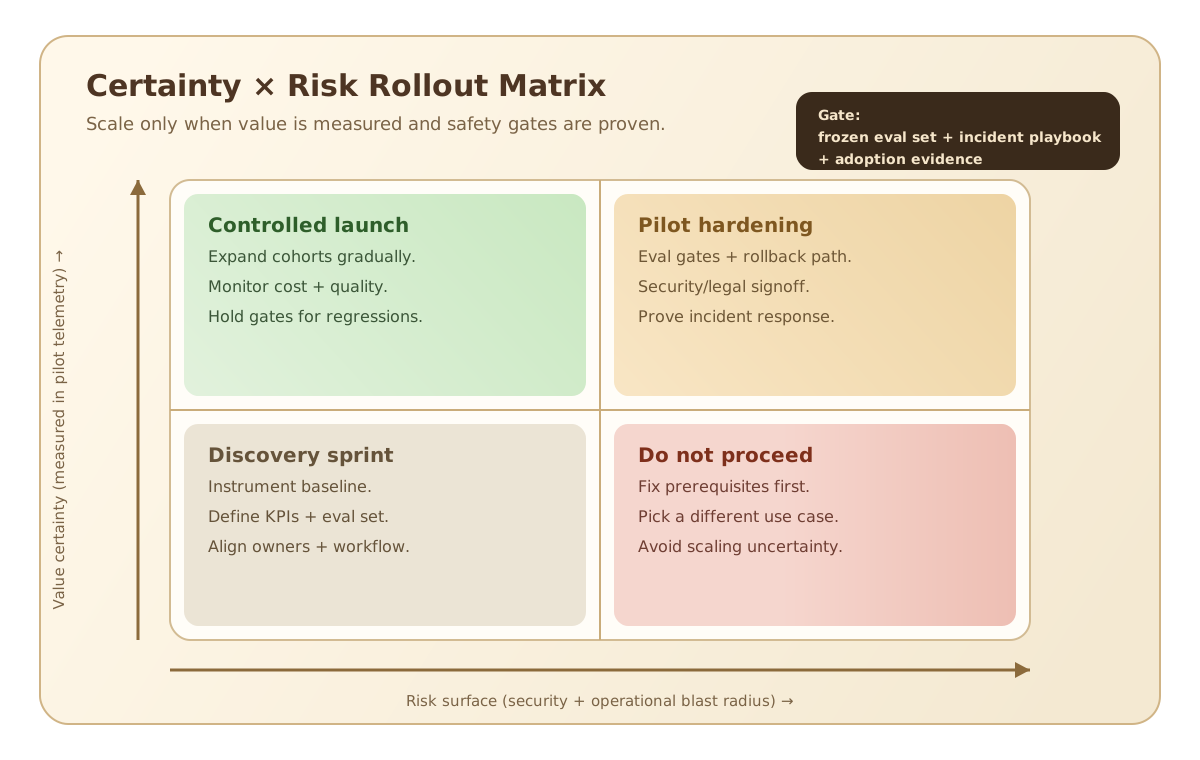
| Criterion | Recommended when | Use caution when |
|---|---|---|
A pilot exists and stakeholders agree on one primary business KPI plus guardrail metrics. | A pilot exists and stakeholders agree on one primary business KPI plus guardrail metrics. | Teams still choosing their first use case with no baseline pilot data. |
Engineering, product, security, and operations can commit to weekly release and evaluation cycles for 13 weeks. | Engineering, product, security, and operations can commit to weekly release and evaluation cycles for 13 weeks. | Organizations without a single accountable business owner for value realization. |
You can create a frozen eval set with pass/fail thresholds before expanding user access. | You can create a frozen eval set with pass/fail thresholds before expanding user access. | Programs blocked by unresolved security, legal, or procurement prerequisites. |
Risk owners accept staged rollout gates instead of a single big-bang launch. | Risk owners accept staged rollout gates instead of a single big-bang launch. | Teams unwilling to gate release on evaluation evidence. |
Observability is available for latency, cost, failure rate, and downstream human rework. | A pilot exists and stakeholders agree on one primary business KPI plus guardrail metrics. | Executives expecting deterministic ROI without workflow or operating-model change. |
You have explicit rollback triggers and an incident response path for model regressions. | A pilot exists and stakeholders agree on one primary business KPI plus guardrail metrics. | Teams still choosing their first use case with no baseline pilot data. |
Phase 1
90-day execution model: Foundation (weeks 1 to 2)
Phase 2
Pilot hardening (weeks 3 to 6)
Phase 3
Controlled rollout (weeks 7 to 10)
Phase 4
Production cutover (weeks 11 to 13).
System flow
Before and after scenario
Weekly loop
Release → eval → ship/hold → expand/rollback
Before
Teams still choosing their first use case with no baseline pilot data.
After
BCG classified 5% of companies in its 2025 survey as future-built, 35% as scaling AI, and 60% as laggards reporting minimal revenue and cost gains.
Evidence lens
BCG classified 5% of companies in its 2025 survey as future-built, 35% as scaling AI, and 60% as laggards reporting minimal revenue and cost gains.
Boston Consulting Group • 2025-09-30 • industry survey
Caveat
Survey of 1,250 senior executives and AI decision makers. These maturity categories do not validate a specific delivery model or a 90-day schedule.
McKinsey’s March 2025 report associates redesigned workflows and CEO oversight of AI governance with greater self-reported EBIT impact from generative AI.
McKinsey & Company • 2025-03 • industry survey
Caveat
The analysis reports associations, not causation. It does not establish faster delivery by consultants or by mixed internal and external teams.
NIST’s Generative AI Profile describes risks and suggested actions across the Govern, Map, Measure, and Manage functions of its AI Risk Management Framework.
National Institute of Standards and Technology • 2024-07-26 • gov publication
Caveat
This voluntary profile can inform risk management. The week-by-week rollout gates on this page are Sophon recommendations, not a NIST-prescribed schedule.
The 2025 edition of OWASP’s LLM application risk list includes prompt injection, sensitive information disclosure, and improper output handling.
OWASP Foundation • 2024-11-17
Caveat
This cites the dated 2025 edition, not a claim that it is the latest. A risk list does not replace application-specific threat modeling and testing.
ISO/IEC 42001:2023 sets requirements for an organization to establish, operate, maintain, and improve an AI management system.
International Organization for Standardization • 2023-12
Caveat
Scope verified from ISO’s public summary. Adopting a management system alone does not establish legal compliance or certify an application as ready for launch.
DORA now uses five delivery metrics: change lead time, deployment frequency, failed deployment recovery time, change fail rate, and deployment rework rate.
Google Cloud DORA • 2026-01-05
Caveat
These describe software delivery throughput and instability for an application or service. They do not measure model quality or AI safety.
Teams still choosing their first use case with no baseline pilot data.
Why: this usually signals governance, ownership, or data-readiness gaps that increase misroute risk.
Organizations without a single accountable business owner for value realization.
Why: this usually signals governance, ownership, or data-readiness gaps that increase misroute risk.
Programs blocked by unresolved security, legal, or procurement prerequisites.
Why: this usually signals governance, ownership, or data-readiness gaps that increase misroute risk.
Teams unwilling to gate release on evaluation evidence.
Why: this usually signals governance, ownership, or data-readiness gaps that increase misroute risk.
Executives expecting deterministic ROI without workflow or operating-model change.
Why: this usually signals governance, ownership, or data-readiness gaps that increase misroute risk.
Why 90 days instead of a longer pilot?
Ninety days is long enough to run multiple release/eval loops while still forcing scope discipline, ownership clarity, and measurable outcomes.
What is the minimum evidence needed for production cutover?
A stable eval pass rate, acceptable change-failure profile, incident runbooks, cost bounds, and demonstrated user adoption in controlled cohorts.
How do we avoid shipping a brittle prompt stack?
Treat prompts as versioned artifacts, run regression evals on every change, and pair prompt updates with retrieval/policy tests before promotion.
Does this include change management and enablement?
Yes.
Weeks 7 to 13 should include role-based training, SOP updates, and adoption instrumentation so rollout quality is measured, not assumed.
Actionable next step
We can pressure-test this decision against your exact workflow, risk posture, and rollout constraints in one working session.
Book an AI discovery call→