Use case

Support Ticket Triage Automation

Short answer

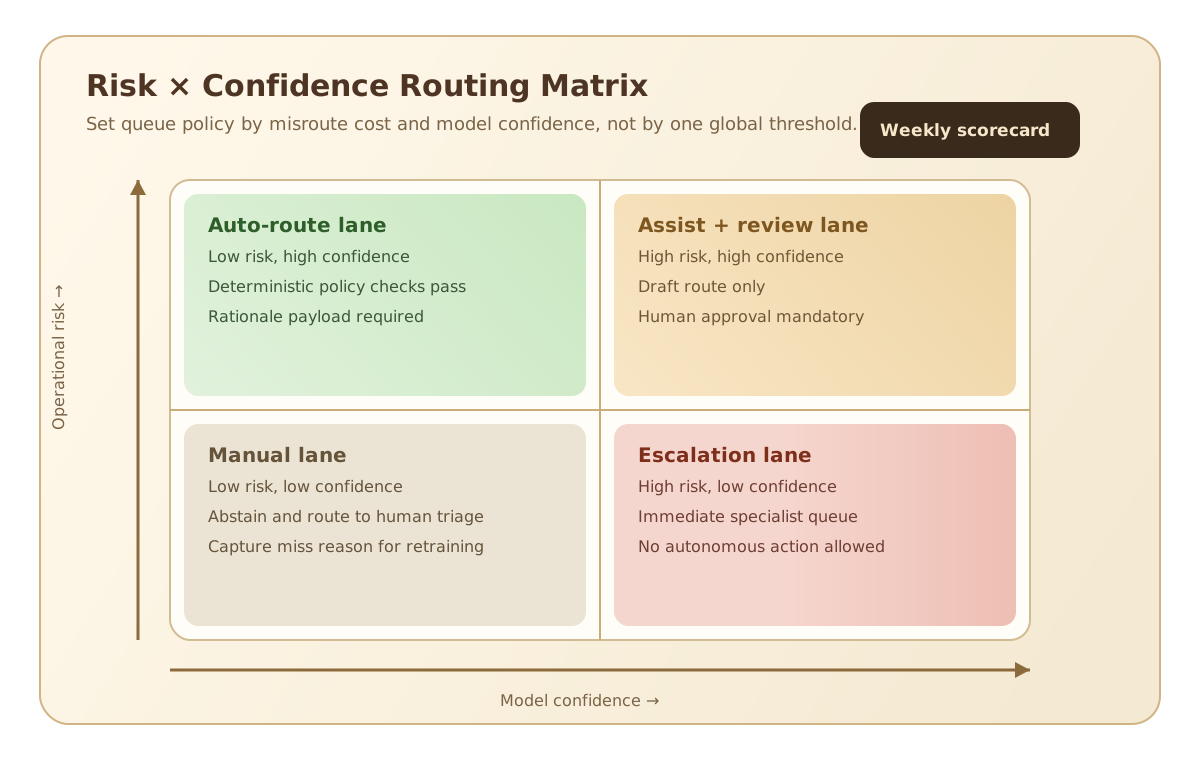
Treat AI triage as a risk control system. Auto-route only low-risk tickets when confidence is high, and send uncertain or high-liability tickets to human review. Log the reason for every routing decision and run a weekly scorecard for precision, abstention, misroutes, SLA impact, and drift.

Support operations command center visual for AI-guided ticket triage
Give operators a practical decision framework for rolling out AI support-ticket triage with measurable throughput gains and governance controls.

Decision narrative

Key takeaways

  • Treat triage as a confidence-gated control system, not full autonomy.
  • Keep billing, security, incident, and legal-adjacent classes in human-owned lanes.
  • Start with one stable queue domain and require rollback readiness before scale.
  • Run a weekly scorecard on precision, abstention, misroute recovery cost, and SLA impact.
  • Anchor controls to NIST/OWASP and validate ROI with local queue telemetry.

Triage is where backlog and SLA outcomes are won or lost.

  • Even low misroute rates compound into backlog and rework.
  • Largest gains appear where novice agents handle heavy ticket volume.
Deep dive and caveats
  • Small efficiency lifts at workforce scale create real capacity.
  • NBER evidence is strong but single-company; treat as directional until validated in your own queue mix.
  • BLS scale data supports economic relevance, but your go/no-go should still be local telemetry driven.

Failure modes to avoid

81%customers wanting conversation continuity

Most bad outcomes come from weak policy and ownership, not weak models.

  • No abstention policy plus unclear escalation ownership creates hidden risk transfer.
  • Auto-routing high-liability classes too early increases legal and trust exposure.
Deep dive and caveats
  • Unchecked misroutes poison labels and degrade future model quality.
  • Zendesk data is a vendor press release with limited methodology details; use as directional expectation signal.

Score triage in three ways before you scale: throughput, risk cost, and change speed.

  • Throughput lens: target queues where routing delay drives backlog and first-touch latency.
  • Risk lens: price wrong-route cost by category before setting thresholds.
Deep dive and caveats
  • Change-velocity lens: ship taxonomy and policy updates as fast as queue drift.
  • Map controls to NIST (Govern, Map, Measure, Manage) and OWASP LLM risks for policy defensibility.

Start with one low-liability queue and expand only after your gates are stable.

  • Pilot one stable intent domain first; keep high-liability classes human-owned.
  • Set queue-specific thresholds by cost of error, not one global confidence score.
Deep dive and caveats
  • Expand only after several weeks of stable scorecard performance.
  • Gartner result is survey-based (200+ leaders); directional for planning, not deterministic for ROI.

Execution sequence

>=95%rationale payload coverage gate

Roll out in phases: baseline, constrained launch, then weekly operations.

  • Weeks 1-2: baseline precision, abstention, recovery cost, and first-touch latency.
  • Weeks 3-6: launch confidence-gated routing in one domain with rollback and override paths.
Deep dive and caveats
  • Week 7 onward: run weekly QA and classify misses by policy, retrieval, model, or integration.
  • Do not widen queue scope until this gate is stable and incident recovery is proven in runbook drills.

Counterarguments and calls

5.4%average user time savings signal

The objections are real. Use them to set scope and controls, not to block progress.

  • Low-volume or volatile queues often fit assistive workflows better than automation.
  • External benchmarks should guide experiments, while local telemetry should decide scale.
Deep dive and caveats
  • High abstention is feedback to improve taxonomy and retrieval before lowering thresholds.
  • Federal Reserve estimate is survey/modeled evidence; combine with controlled local measurement for decisions.

Decision matrix

Risk and confidence decision matrix for support ticket triage
Risk-confidence matrix with mandatory human-review lanes and auto-route lanes
CriterionRecommended whenUse caution when

Ticket volume and repeat intent patterns are high enough that routing quality materially affects backlog and response time.

You need faster first-touch routing but cannot accept opaque automation in billing, security, incident, or legal-adjacent queues.

Ticket categories change constantly and there is no stable policy owner to maintain taxonomy and escalation logic.

Expand row details

Criterion

Ticket volume and repeat intent patterns are high enough that routing quality materially affects backlog and response time.

Recommended

You need faster first-touch routing but cannot accept opaque automation in billing, security, incident, or legal-adjacent queues.

Use caution

Ticket categories change constantly and there is no stable policy owner to maintain taxonomy and escalation logic.

Queue taxonomy, escalation ownership, and SLA policy are explicit enough to encode deterministic guardrails.

Current manual triage consumes senior agent time that should be spent on resolution and customer communication.

The organization expects full autonomy and will not fund human fallback for uncertain or high-risk classifications.

Historical resolved tickets and internal policy artifacts are available for baseline measurement and retrieval-grounded reasoning.

You can operationalize confidence thresholds, abstention rules, and mandatory rationale fields before any auto-routing action.

Historical ticket labels are noisy, unavailable, or politically disputed across teams.

Expand row details

Criterion

Historical resolved tickets and internal policy artifacts are available for baseline measurement and retrieval-grounded reasoning.

Recommended

You can operationalize confidence thresholds, abstention rules, and mandatory rationale fields before any auto-routing action.

Use caution

Historical ticket labels are noisy, unavailable, or politically disputed across teams.

Support leadership can run ongoing QA, not just launch-time model evaluation, with clear accountability for false-positive and false-negative costs.

Leadership is prepared to treat triage as a living operations system with weekly failure analysis and policy updates.

Tooling decisions are being made before operating model readiness, QA process, and risk policy are defined.

Expand row details

Criterion

Support leadership can run ongoing QA, not just launch-time model evaluation, with clear accountability for false-positive and false-negative costs.

Recommended

Leadership is prepared to treat triage as a living operations system with weekly failure analysis and policy updates.

Use caution

Tooling decisions are being made before operating model readiness, QA process, and risk policy are defined.

Owners agree on a weekly scorecard (precision, abstention rate, misroute recovery effort, first-touch latency, and escalation leakage) and who can change thresholds.

The program can align controls to NIST and OWASP frameworks and publish a weekly operator scorecard that is auditable by risk, security, and support leadership.

Leadership treats triage as a one-time model deployment instead of an ongoing service operation.

Expand row details

Criterion

Owners agree on a weekly scorecard (precision, abstention rate, misroute recovery effort, first-touch latency, and escalation leakage) and who can change thresholds.

Recommended

The program can align controls to NIST and OWASP frameworks and publish a weekly operator scorecard that is auditable by risk, security, and support leadership.

Use caution

Leadership treats triage as a one-time model deployment instead of an ongoing service operation.

Security and compliance teams can approve a bounded automation scope where high-liability categories always route through human review.

You need faster first-touch routing but cannot accept opaque automation in billing, security, incident, or legal-adjacent queues.

Ticket categories change constantly and there is no stable policy owner to maintain taxonomy and escalation logic.

Expand row details

Criterion

Security and compliance teams can approve a bounded automation scope where high-liability categories always route through human review.

Recommended

You need faster first-touch routing but cannot accept opaque automation in billing, security, incident, or legal-adjacent queues.

Use caution

Ticket categories change constantly and there is no stable policy owner to maintain taxonomy and escalation logic.

Timeline and process strip

Three-phase rollout with entry/exit gates and owner handoffs

  1. Phase 01

    Baseline + Policy

    Define controls before any autonomous routing.

    0

    critical queues auto-routed

    100%

    taxonomy ownership assigned

    • Named taxonomy and escalation owners
    • SLA risk bands and protected queues mapped
    • Evidence payload requirements documented

    Gate: Baseline dashboard approved; high-liability queues remain human review only.

  2. Phase 02

    Constrained Launch

    Launch one domain with confidence-gated routing only.

    >=95%

    rationale payload coverage

    1

    domain live in pilot scope

    • Thresholds and abstention policy live
    • Rollback path tested in production-like traffic
    • Rationale payload attached to every route decision

    Gate: Misroutes bounded, rollback proven, rationale coverage >= 95%.

  3. Phase 03

    Ops Cadence

    Operate triage as a weekly quality system.

    1x/wk

    cross-functional QA forum

    4

    root-cause classes tracked

    • Cross-functional QA review cadence running
    • Threshold ownership and drift response assigned
    • Policy, retrieval, and model fixes tracked by root cause

    Gate: Precision and SLA trend stable; abstention and recovery cost within budget.

Example scenario: before and after

Ticket-flow comparison: manual baseline vs confidence-gated AI triage

5.4%average time saved
Ticket intake
Model scoring
Policy check
Confidence gate
High confidence + low risk

Auto-route queue

  • Route automatically
  • Persist rationale payload
  • Start SLA timer immediately
Low confidence or risk flag

Human review

  • Route to specialist queue
  • Require override reason
  • Capture correction for retraining

Weekly loop

Audit misses -> classify root cause -> update thresholds, policy, and prompt.

Before

Ticket categories change constantly and there is no stable policy owner to maintain taxonomy and escalation logic.

After

NBER working paper w31161 reports a 14% increase in issues resolved per hour across 5,179 support agents with AI assistant access.

Evidence snapshot

Evidence lens

AI copilots can materially raise support throughput in real ticket workflows.

+14%high

National Bureau of Economic Research • 2023-11 (revision) • working paper

Generative AI at Work (NBER Working Paper w31161)
Details

Metric context

+14% issues resolved per hour with AI assistant access (study of 5,179 support agents).

Caveat

Single-company context; validate lift against your queue mix and agent tooling.

Largest productivity lift is for less experienced support reps.

+34%high

National Bureau of Economic Research • 2023-11 (revision) • working paper

Generative AI at Work (NBER Working Paper w31161)
Details

Metric context

+34% productivity for novice and low-skill workers.

Caveat

Same context as w31161; novice gains may vary with training quality and workflow design.

Reported GenAI usage suggests meaningful time savings among current users.

5.4%medium

Federal Reserve Bank of St. Louis • 2025-02-03 • gov publication

The Impact of Generative AI on Work and Productivity
Details

Metric context

Average time savings equal to 5.4% of work hours among users.

Caveat

Self-reported time savings; not a controlled support-only experiment.

Current GenAI adoption levels map to non-trivial macro productivity upside.

+1.1%medium

Federal Reserve Bank of St. Louis • 2025-02-03 • gov publication

The Impact of Generative AI on Work and Productivity
Details

Metric context

Estimated +1.1% aggregate labor productivity effect; +33% productivity on genAI-assisted hours.

Caveat

Modeled macro estimate; treat as directional, not direct enterprise KPI evidence.

Enterprise AI governance should cover full lifecycle functions, not only model quality.

4high

National Institute of Standards and Technology • 2023-01-26 (updated 2025-02-03) • gov publication

NIST Risk Management Framework Aims to Improve Trustworthiness of AI Products, Systems
Details

Metric context

AI RMF defines 4 functions: Govern, Map, Measure, Manage.

Caveat

Process guidance informs governance design; outcomes still depend on local execution quality.

Who this is not for

Ticket categories change constantly and there is no stable policy owner to maintain taxonomy and escalation logic.

Why: without stable ownership, taxonomy drifts and misroutes spike as queues and policies change.

The organization expects full autonomy and will not fund human fallback for uncertain or high-risk classifications.

Why: low-confidence and high-liability intents need human lanes to prevent trust and compliance exposure.

Historical ticket labels are noisy, unavailable, or politically disputed across teams.

Why: noisy labels break evaluation and calibration, so threshold tuning turns into politics instead of telemetry.

Tooling decisions are being made before operating model readiness, QA process, and risk policy are defined.

Why: tool-first launches ship without gates, so you cannot bound error cost, rollback safely, or learn fast.

Leadership treats triage as a one-time model deployment instead of an ongoing service operation.

Why: triage is a service; without a weekly ops cadence, drift and misroutes quietly accumulate.

FAQ

What should auto-route versus mandatory human review?

Auto-route only low-liability categories with stable policy and reliable confidence calibration.

Read full answer

Keep billing disputes, security concerns, incident-class tickets, and ambiguous requests in mandatory human review until error cost is well characterized.

How should we set confidence thresholds?

Set thresholds per queue based on misroute cost, not one global number.

Read full answer

Treat abstention as a control feature. Tune with real post-route outcomes, then adjust gradually as taxonomy and retrieval quality improve.

How do we keep the system from drifting over time?

Run a weekly review that samples false routes, abstentions, and escalations.

Read full answer

Attribute each miss to policy, retrieval, model, or integration causes, then fix in that order. This preserves quality while keeping operating overhead predictable.

Can we justify investment if external studies are mixed quality?

Yes, if you use external studies only to prioritize exploration.

Read full answer

Final go/no-go decisions should rely on your own queue telemetry from a constrained rollout with clear baseline and post-launch measurement.

What does a strong first deployment look like?

A strong first deployment has explicit scope boundaries, mandatory routing rationale, reversible automation actions, named policy owners, and a recurring governance forum that can ship fixes quickly.

Actionable next step

We can pressure-test this decision against your exact workflow, risk posture, and rollout constraints in one working session.

Book an AI discovery call