
Why now
20NIST control familiesDeep dive and caveats
- Weekly sampling prevents quiet drift that surfaces only during the audit window.
- Control catalogs do not guarantee compliance; the differentiator is evidence quality and operating cadence.
Use case
Short answer
Automate evidence assembly, not evidence creation. Map each control to verifiable artifacts in systems of record, assemble packets with traceable links, and run weekly human signoff. Use LLMs to summarize evidence, and keep attestations and exceptions human-owned.

Key takeaways
Why now
20NIST control familiesFailure modes to avoid
5SOC 2 scope categoriesDecision framework
7RMF lifecycle stepsRecommended path
AI 600-1GenAI governance profileImplementation sequence
Top 10LLM security risksTradeoffs and counterarguments
5.4%time savings signal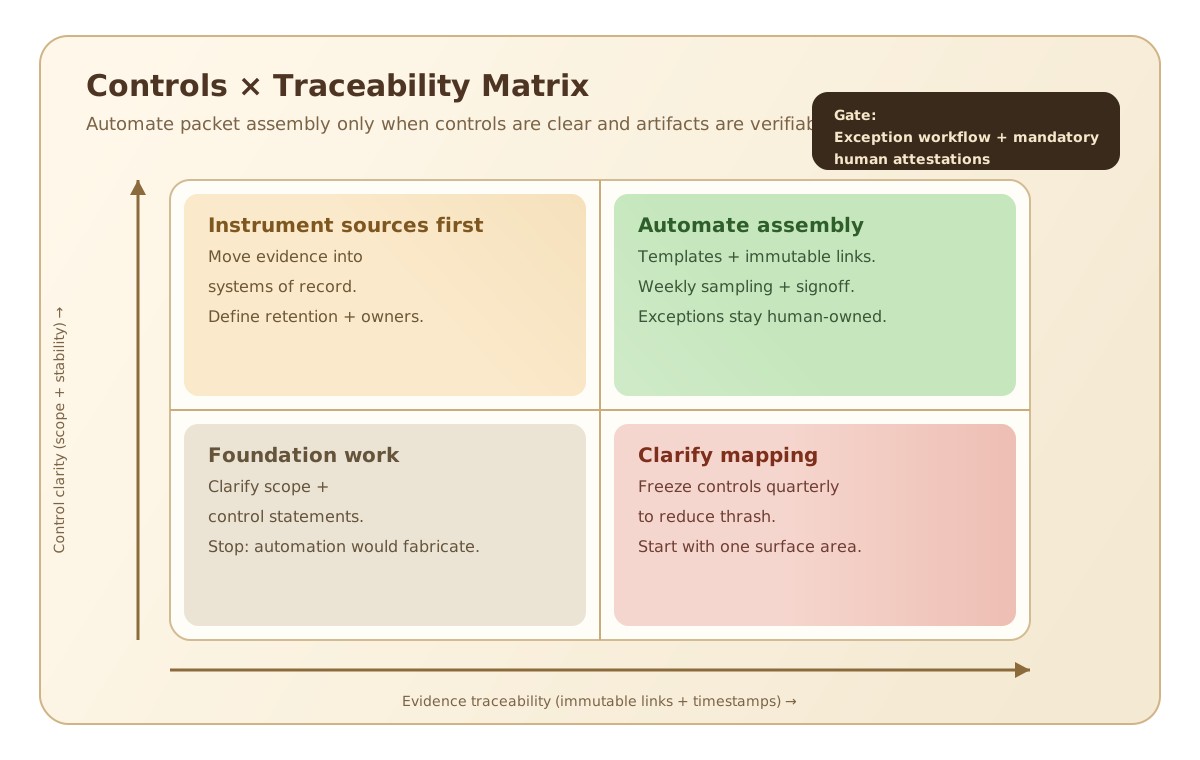
| Criterion | Recommended when | Use caution when |
|---|---|---|
Audit preparation is a recurring fire drill because evidence is scattered across tools and teams. | Controls change weekly or are ambiguous, so mapping work will thrash. | |
Expand row detailsCriterion Control framework scope is defined (SOC 2, ISO 27001, NIST 800-53, internal controls) with stable control statements for at least a quarter. Recommended Audit preparation is a recurring fire drill because evidence is scattered across tools and teams. Use caution Controls change weekly or are ambiguous, so mapping work will thrash. | ||
Controls are stable enough that evidence can be specified once and verified repeatedly. | There is no system of record for evidence (logs/tickets/access reviews), only ad hoc documents. | |
Expand row detailsCriterion Evidence already exists in systems of record (tickets, logs, access reviews, CI/CD, HR, vendor management), not only in spreadsheets. Recommended Controls are stable enough that evidence can be specified once and verified repeatedly. Use caution There is no system of record for evidence (logs/tickets/access reviews), only ad hoc documents. | ||
You can map each control to an evidence definition (what, where, who signs, retention period, sampling frequency). | You need faster partner/customer due diligence responses without weakening traceability. | Teams will not sign off evidence packets weekly, so quality will silently decay. |
You can enforce immutable links and timestamps (audit trail) so packets are verifiable. | You can start with one audit surface (e.g., access reviews or incident response) and expand by gates. | Leadership expects the model to “generate evidence” rather than assemble verifiable artifacts. |
Compliance/security leadership can run a weekly sampling and exception review cadence (not just pre-audit scramble). | You can fund the operating model: weekly sampling, ownership, and change control. | You cannot enforce access boundaries; evidence automation can become a data-leak vector. |
You have a clear escalation path for exceptions (missing evidence, control drift, suspicious activity). | Audit preparation is a recurring fire drill because evidence is scattered across tools and teams. | Controls change weekly or are ambiguous, so mapping work will thrash. |
Phase 1
Baseline the current workflow, metrics, and risk thresholds.
Phase 2
Run a constrained pilot with explicit quality and governance gates.
Phase 3
Scale only after evidence confirms reliability, cost, and adoption targets.
System flow
Before and after: pre-audit scramble vs always-ready evidence packets
Weekly loop
Sample → exceptions → update mappings/connectors/policy
Before
Controls change weekly or are ambiguous, so mapping work will thrash.
After
NIST SP 800-53 Rev. 5 enumerates 20 control families, illustrating why evidence mapping must be systematic, not ad hoc.
Evidence lens
Compliance evidence work is fundamentally a controls mapping problem; mature catalogs already exist.
National Institute of Standards and Technology (CSRC) • 2020-12-10 • gov publication
Metric context
NIST SP 800-53 lists 20 control families.
Caveat
Control catalogs define coverage, not the quality of your operational evidence.
A repeatable evidence system needs a lifecycle process, not a one-time audit scramble.
National Institute of Standards and Technology (CSRC) • 2018-12-20 • gov publication
Metric context
RMF has 7 steps: Prepare → Monitor.
Caveat
RMF is a process model; you still need local telemetry and owners.
SOC 2 assurance scope is structured around five Trust Services Categories.
AICPA • 2022 • industry survey
Metric context
5 categories: Security, Availability, Processing Integrity, Confidentiality, Privacy.
Caveat
Baseline scope reference; auditors still require traceable underlying evidence.
Enterprise AI governance should cover lifecycle functions, not only model outputs.
National Institute of Standards and Technology • 2023-01-26 (updated 2025-02-03) • gov publication
Metric context
AI RMF defines 4 functions: Govern, Map, Measure, Manage.
Caveat
Governance guidance informs design; outcomes depend on operating discipline.
There is a GenAI-specific profile to anchor evidence and governance expectations.
National Institute of Standards and Technology • 2024-07-26 • gov publication
Metric context
NIST GenAI profile: NIST AI 600-1 (2024-07-26).
Caveat
Framework publication confirms control baseline, not audit efficiency lift.
LLM-based evidence assistants need a minimum security baseline aligned to OWASP LLM risks.
OWASP Foundation • 2025 • industry survey
Metric context
OWASP Top 10 for LLM Applications (v1.1).
Caveat
Risk taxonomy supports threat coverage, but does not quantify incident rates.
Controls change weekly or are ambiguous, so mapping work will thrash.
Why: this usually signals governance, ownership, or data-readiness gaps that increase misroute risk.
There is no system of record for evidence (logs/tickets/access reviews), only ad hoc documents.
Why: this usually signals governance, ownership, or data-readiness gaps that increase misroute risk.
Teams will not sign off evidence packets weekly, so quality will silently decay.
Why: this usually signals governance, ownership, or data-readiness gaps that increase misroute risk.
Leadership expects the model to “generate evidence” rather than assemble verifiable artifacts.
Why: this usually signals governance, ownership, or data-readiness gaps that increase misroute risk.
You cannot enforce access boundaries; evidence automation can become a data-leak vector.
Why: this usually signals governance, ownership, or data-readiness gaps that increase misroute risk.
Does this generate evidence for us?
No.
It assembles evidence packets from underlying systems of record and summarizes them. Humans still attest and sign off; the system improves speed and traceability, not truth.
What is the first surface area to automate?
Start where evidence already exists and is repetitive: access reviews, vulnerability management, change management, incident response, or vendor-risk workflows.
Avoid broad scope until weekly sampling is stable.
How do we keep evidence packets from drifting out of date?
Run a weekly sampling loop: pick a set of controls, verify evidence freshness and traceability, log exceptions, and fix connectors/policies before expanding scope.
How do we handle exceptions and missing evidence?
Exceptions are first-class.
Every missing artifact should create a tracked task, an owner, and a deadline. If you cannot operate exceptions, automation will hide the problem until audit time.
What security controls are mandatory for an evidence assistant?
Identity-aware access, immutable audit logs, prompt-injection and data-exfiltration testing, and restricted tool/action boundaries.
Map security coverage to OWASP LLM risks before broad rollout.
Actionable next step
We can pressure-test this decision against your exact workflow, risk posture, and rollout constraints in one working session.
Book an AI discovery call→