
Why now
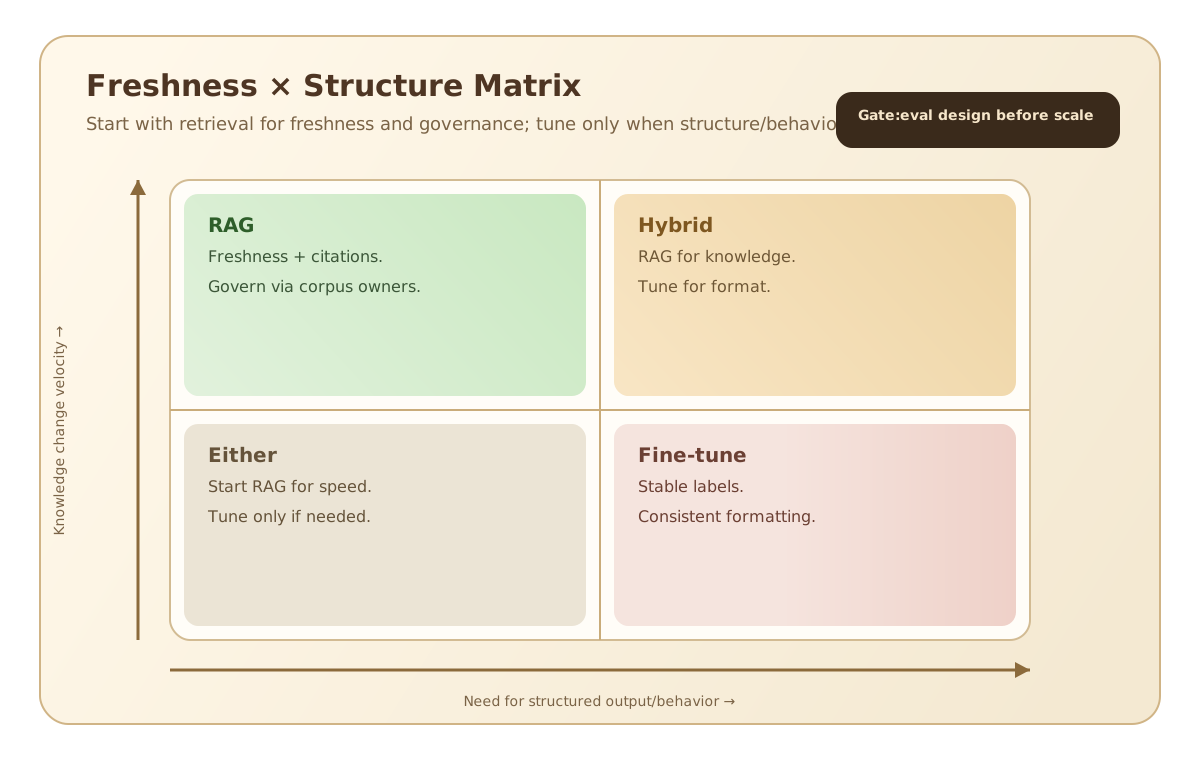
Start with RAG for changing knowledge and traceable citations. Fine-tune only when retrieval cannot deliver the behavior you need.
- Knowledge freshness requirements and update frequency.
Comparison
Short answer
Start with RAG for changing knowledge and traceable citations. Fine-tune only when retrieval cannot deliver the behavior you need.

Option A
Retrieval augmented generation
Option B
Fine-tuned model stack
Verdict
RAG usually wins for evolving knowledge domains and faster governance cycles.
Key takeaways
Why now
What breaks without this
Decision framework
Recommended path
Implementation sequence
Tradeoffs and counterarguments
| Criterion | Recommended when | Use caution when |
|---|---|---|
Knowledge freshness requirements and update frequency. | Knowledge freshness requirements and update frequency. | Teams with no curated corpus to retrieve from. |
Need for citation traceability and source-level permissions. | Need for citation traceability and source-level permissions. | Organizations unable to evaluate hallucination and grounding quality. |
Task-specific behavior gaps after prompt and retrieval optimization. | Task-specific behavior gaps after prompt and retrieval optimization. | Projects where retraining pipelines cannot be maintained. |
Phase 1
Baseline the current workflow, metrics, and risk thresholds.
Phase 2
Run a constrained pilot with explicit quality and governance gates.
Phase 3
Scale only after evidence confirms reliability, cost, and adoption targets.
System flow
Before and after scenario
Decision loop
Eval first → pick baseline → iterate → re-evaluate when corpus changes
Before
Teams with no curated corpus to retrieve from.
After
RAG deployments ship faster because corpus updates avoid retraining.
Teams with no curated corpus to retrieve from.
Why: this usually signals governance, ownership, or data-readiness gaps that increase misroute risk.
Organizations unable to evaluate hallucination and grounding quality.
Why: this usually signals governance, ownership, or data-readiness gaps that increase misroute risk.
Projects where retraining pipelines cannot be maintained.
Why: this usually signals governance, ownership, or data-readiness gaps that increase misroute risk.
Can we combine both?
Yes.
Hybrid setups are common when retrieval handles freshness and tuning improves style or structure.
What is the biggest implementation risk?
Skipping evaluation design, which makes quality regressions hard to detect and fix.
Actionable next step
We can pressure-test this decision against your exact workflow, risk posture, and rollout constraints in one working session.
Book an AI discovery call→